VPN vs Proxy: What's the Difference?
Table of Contents
“VPN” and “proxy” both move traffic through an intermediary, so marketing pages blur them constantly. They are not the same tool. A VPN typically extends or relocates the network layer for a whole device (or a routed subnet). A proxy typically forwards traffic for a specific application protocol—most often HTTP/HTTPS—without creating a system-wide encrypted tunnel.
If you design remote access, egress controls, or debugging tooling, picking the wrong one wastes time and creates false security assumptions. This article separates the concepts by layer, trust model, and operational use so you can choose deliberately.
What You'll Learn
- How VPNs and proxies differ at the network and application layers
- What each encrypts—and what each does not
- Typical engineering use cases for both
- How SOCKS, HTTP proxies, and VPN tunnels compare
- Best practices when combining or choosing between them
- Common mistakes and misconceptions
What a VPN Is
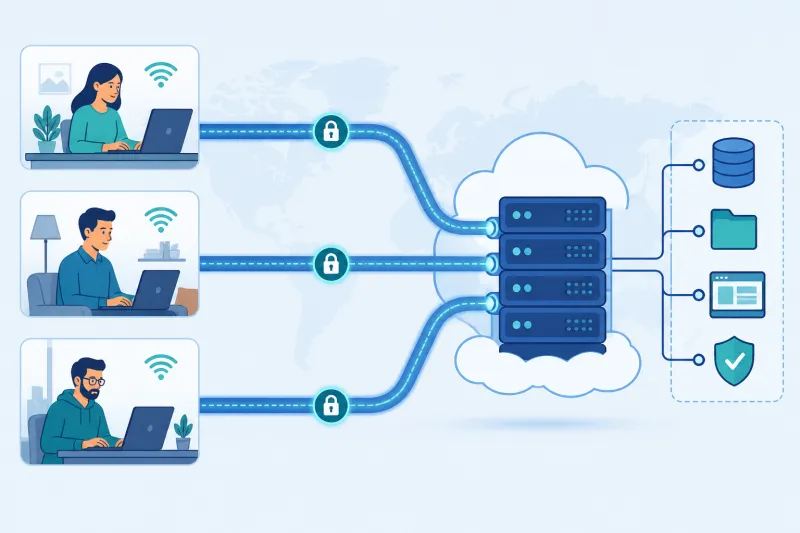
A virtual private network creates an encrypted tunnel between your system (or gateway) and a remote endpoint. Inside the tunnel, IP packets flow as if you had another network interface—wg0, tun0, or an IPsec policy. Applications do not need to be proxy-aware; they bind and connect as usual, and routing decides whether sockets traverse the tunnel.
Consequences of that model:
- System-wide (or route-scoped) coverage. All TCP/UDP (and more) can go through the tunnel if routes say so.
- Encryption of the outer tunnel. Observers between client and VPN server see ciphertext (plus metadata such as server IP and timing).
- New source IP for destination sites. From the internet’s point of view, traffic exits from the VPN server’s address (for full-tunnel egress designs).
- Operational duties. Keys/certs, firewall ports, IP pools, keepalive, MTU.
Protocols you will meet: WireGuard, OpenVPN, IKEv2/IPsec, and older stacks. The brand of protocol changes crypto and ops; the architectural idea—layer-3 (sometimes layer-2) tunnel—stays stable.
What a Proxy Is
A proxy accepts a connection from a client and makes a separate connection toward the destination on the client’s behalf. The client must speak the proxy protocol (or be forced through a transparent proxy).
Common variants:
HTTP/HTTPS forward proxy. Browsers or CLIs send requests to the proxy. For HTTPS, the client uses CONNECT to ask the proxy to dig a TCP tunnel to the target host:443; end-to-end TLS still terminates at the origin unless you deliberately intercept.
SOCKS5. A more general TCP (and optionally UDP) shim used by apps that support SOCKS. Still application-selected unless you use redsocks-style transparent tricks.
Reverse proxy. Sits in front of your servers (Caddy, nginx, cloud load balancers) to terminate TLS and route to backends. Related vocabulary, different direction—do not confuse forward and reverse proxies when troubleshooting.
Proxies shine when you want per-app control, caching, HTTP filtering, or to pierce a corporate boundary without installing a system VPN profile.
Layered Comparison
| Dimension | VPN | Forward proxy |
|---|---|---|
| OSI focus | L3 (IP) / sometimes L2 | L7 (HTTP) or L5-ish (SOCKS) |
| App awareness | Usually none | Required (or transparent forcing) |
| Encryption | Tunnel encrypted by design | Depends; HTTP proxy may see plaintext HTTP |
| Scope | Routes / whole device | Per application or PAC file |
| Non-TCP protocols | Generally yes (per routes) | Limited / varies |
| Identity model | Peer keys, certs, EAP | Often user/pass, IP allowlists, mTLS |
A useful mental test: Can an arbitrary UDP game or ICMP check use it without special support? If you need a general answer of yes, you want a VPN (or a very specialized transparent proxy setup). If you only need browser egress, a proxy may be enough.
Encryption Myths
Myth: “Proxies encrypt everything.”
A plain HTTP proxy can read and modify HTTP. HTTPS CONNECT proxies usually do not see request bodies—they forward ciphertext after the CONNECT tunnel is up—unless they perform TLS interception with a corporate root CA.
Myth: “VPNs make you anonymous.”
The VPN server operator (and its provider) still see that your IP connected and when. Destinations see the VPN exit IP. Threat models involving anonymity networks are a different discussion.
Myth: “If I use both, I’m double safe.”
VPN-over-proxy or proxy-over-VPN can be valid for constrained networks, but complexity rises fast. Misordered stacks leak DNS or fail open to the wrong path.
When Engineers Choose a VPN
- Remote employees need access to private RFC1918 services as if on the LAN
- You want all device traffic (or selected prefixes) to exit a controlled VPS
- You run site-to-site links between offices or cloud VPCs
- You need a consistent overlay for SSH, databases, internal APIs, and ICMP alike
Self-hosted VPN on a VPS you control is about network reachability and encryption under your keys, not about renting a consumer privacy brand.
When Engineers Choose a Proxy
- Only browsers or package managers need a different egress
- You must inspect or allowlist HTTP(S) hosts at an enterprise boundary
- An application supports
HTTPS_PROXY/ALL_PROXYand you refuse to change system routes - You are scraping, testing geo headers, or debugging CDN behavior with a single client
Developers often keep a local SOCKS proxy via SSH dynamic forwarding (ssh -D) as a quick tactical tool. That is a proxy (SOCKS) transported over SSH—still not a full VPN unless you also hijack routes.
DNS: The Leak That Betrays Both
Whether you use a VPN or a proxy, DNS path decides whether domain lookups reveal intent.
- Full-tunnel VPNs should push or enforce DNS that goes through the tunnel (or to a trusted resolver via the tunnel).
- Proxies may resolve names on the client before connecting (especially poorly configured SOCKS) or let the proxy resolve. Know which.
“Connected to VPN but DNS still hits the coffee-shop resolver” is a classic failure. Test with deliberate lookups and packet captures when security depends on it.
Can You Combine Them?
Yes, with clear intent:
VPN for private nets + proxy for HTTP policy. Laptop joins WireGuard for 10.0.0.0/8 access; browser still uses a corporate HTTP proxy for web filtering.
Proxy to reach a VPN port on restricted networks. Rare but seen when only HTTP CONNECT to port 443 is allowed; usually OpenVPN-over-TCP or similar is cleaner than folklore setups.
SSH SOCKS while traveling as a stopgap until a real VPN profile works.
Document the intended path. Undocumented combinations become “it works on my machine” folklore.
Practical Decision Guide
- Do you need non-HTTP applications to use the path? → Prefer VPN.
- Do you only need one app and already have proxy settings? → Proxy may suffice.
- Do you need to expose a private overlay to many protocols? → VPN.
- Do you need HTTP caching/filtering? → Proxy (possibly plus VPN for transport security to the proxy).
- Do you control both ends and want minimal ops? → Often WireGuard VPN on a VPS.
Best Practices
-
Name the threat model. Eavesdropping on hotel Wi-Fi, reaching private APIs, and bypassing geo ads are three different problems.
-
Prefer split-tunnel VPNs when full egress is unnecessary. Less hairpin bandwidth, clearer failure domains.
-
Enforce DNS intentionally for whichever tool you pick.
-
Do not send secrets through HTTP proxies without TLS. Obvious, still violated by legacy tools.
-
Log retention on intermediaries is a policy choice. Your VPN VPS or corporate proxy may store connection metadata.
-
Test fail-open versus fail-closed. If the VPN drops, should traffic leak to local Wi-Fi or blackhole? Same question for mandatory proxies.
-
Keep reverse proxies out of the mental model unless relevant. Different job.
-
Automate user access on VPNs; automate PAC/config for proxies. Both rot without inventory.
Common Mistakes
Calling a browser extension “a VPN.” Many are proxies with bold branding.
Assuming HTTPS through a proxy equals a system VPN. Other apps still use the raw network.
Full-tunnel consumer VPN for access to one private IP. Heavy solution; split tunnel or SSH would do.
Ignoring UDP. Proxies often struggle where VPNs handle UDP natively.
Double NAT and hairpinning without measuring latency. Performance complaints follow.
Using an untrusted free proxy with corporate credentials. Credential harvest as a service.
Forgetting cloud firewall rules when self-hosting a VPN and blaming “VPN protocol” for connection timeouts.
Treating exit IP reputation as irrelevant. Shared proxy pools and dirty VPS IPs both get CAPTCHA storms.
FAQ
Is a VPN just a fancy proxy?
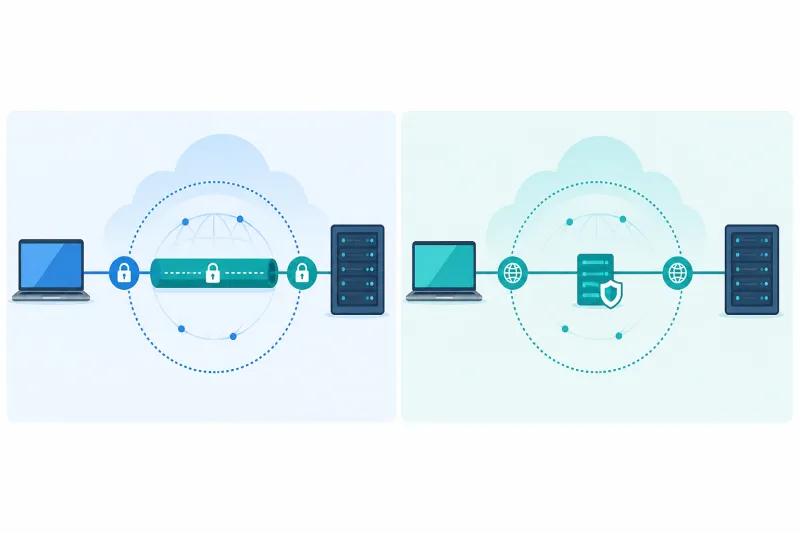
No. A VPN is a tunnel for IP traffic with routing semantics. A proxy is an application hop for supported protocols.
Which is faster?
Neither wins universally. Local proxies add minimal hops for HTTP. VPNs add crypto and an extra network path. Measure your path; do not trust brand claims.
Which is more secure?
Security depends on configuration and trust in the intermediary. A well-run self-hosted WireGuard server can be stronger than a random proxy; a misconfigured VPN with logging and weak auth can be worse than a tightly controlled corporate HTTPS proxy.
Does SOCKS5 encrypt traffic?
SOCKS5 itself is not an encryption layer. Encryption comes from the payload (TLS) or from wrapping SOCKS inside SSH/VPN.
Can a proxy replace site-to-site VPN?
Not realistically for general IP connectivity between LANs. Use site-to-site VPN or cloud networking products.
Why do websites detect “VPN or proxy”?
Exit IP ranges are catalogued. Datacenter ASNs look different from residential ISPs. Detection is about IP reputation, not mystical protocol fingerprints alone.
Is SSH port forwarding a VPN?
-L/-R are point forwards; -D is a SOCKS proxy. Useful, but not a full tun device. Tools like sshuttle blur lines by emulating VPN-like routing over SSH.
Do I need both for remote work?
Often VPN alone is enough for private resource access. Add a proxy when HTTP policy or legacy app settings demand it.
What should I self-host on a VPS?
For whole-device or multi-protocol access, self-host a VPN. For HTTP-only debugging, a small forward proxy can be enough—but lock it down hard; open proxies become abuse magnets instantly.
How does TunnelFleet fit?
TunnelFleet focuses on provisioning and managing VPN servers on your cloud provider—not on operating public proxy farms. Use the right intermediary type for the job.
Summary
VPNs tunnel IP traffic through an encrypted network path and change how the OS routes packets. Proxies forward specific application protocols through an intermediary that clients must know how to speak. Encryption, scope, and operational complexity differ; marketing synonyms do not.
If you remember only a few points:
- VPN = routing + tunnel; proxy = app-level hop
- HTTPS via proxy ≠ system-wide protection
- DNS path is part of the design
- Choose based on protocols you must carry, not on buzzwords
- Self-host VPNs for overlays you control; lock down any proxy you expose
Pick deliberately, test leaks, and document the intended traffic path for the next person who debugs it at 2 a.m.
If you want to automate VPN server deployment instead of configuring everything manually, TunnelFleet helps you provision and manage VPN infrastructure on your own cloud provider with minimal manual setup.
Share this article
Practical guides on VPN infrastructure, server automation, and self-hosted networking from the TunnelFleet team.
View all articles by TunnelFleet Editorial →