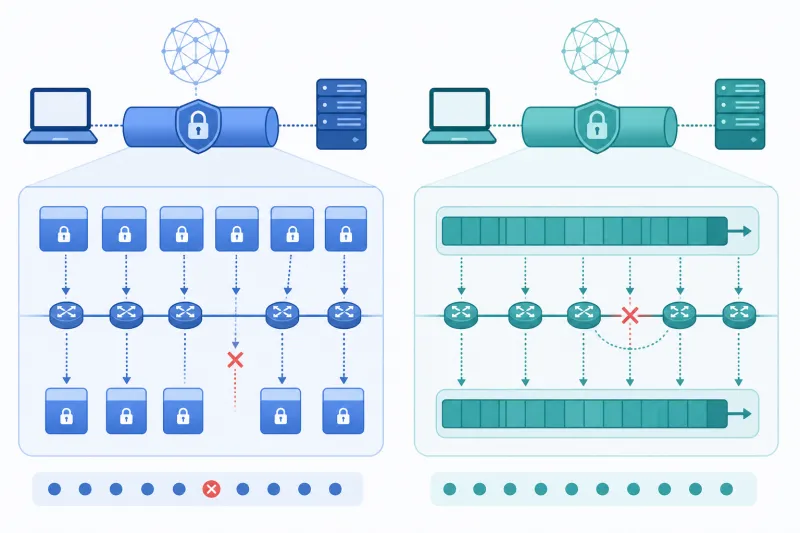
UDP vs TCP for VPNs
Table of Contents
VPN protocols ride on an outer transport. That outer choice—UDP or TCP—shapes latency, loss recovery, firewall traversal, and failure modes. WireGuard speaks UDP only. OpenVPN can use either. Teams often switch to TCP because “TCP is reliable,” then discover transfers get worse on lossy networks. This guide explains the trade-offs in operational terms so you can pick deliberately.
What You'll Learn
- How UDP and TCP behave as VPN outer transports
- Why WireGuard is UDP-native and what that implies
- When OpenVPN TCP is justified
- What TCP-over-TCP meltdown looks like
- How firewalls and hotel networks change the decision
- Best practices, mistakes, and FAQ
Transport Roles (Not Cryptography)
UDP and TCP here are outer transports: how encrypted VPN packets move between client and server across the internet. Inside the tunnel you may carry TCP (HTTPS, SSH) or UDP (DNS, games, VoIP) as usual.
- UDP outer: each VPN datagram is independent at the transport layer; loss recovery is left to inner protocols or the VPN’s own mechanisms.
- TCP outer: the VPN stream is retransmitted and ordered by TCP even if the inner payload already had its own reliability.
Reliability is not free. Two nested reliability layers interact badly under packet loss.
Why Most VPNs Prefer UDP
Performance under loss
Inner TCP already retransmits. If the outer layer also retransmits and blocks the pipeline (classic TCP-over-TCP), throughput collapses on Wi‑Fi and congested links. UDP outer lets inner TCP implement its own congestion control without a second governor fighting it.
Latency and jitter
UDP avoids head-of-line blocking from an outer TCP session. Interactive traffic (SSH, video calls inside the tunnel) usually feels better.
Protocol fit
WireGuard’s design assumes UDP. Roaming and quick handshakes align with datagram semantics. Forcing WireGuard through a TCP wrapper adds another moving part and usually costs speed.
Efficiency
Less framing overhead and no outer TCP ACK tax on every flight of packets.
When TCP Transport Still Wins
Choose TCP (typically OpenVPN on TCP/443) when:
- UDP is blocked or unreliable on the client network (strict corporate firewalls, captive portals, some mobile APNs).
- You must blend with HTTPS-ish traffic on port 443 to pass crude filters (note: this is camouflage-lite, not a guarantee against DPI).
- A minority compatibility endpoint is cheaper than endless UDP troubleshooting for a few users.
TCP is a reachability tool. It is not a general upgrade for “more stable VPN.”
WireGuard and UDP
WireGuard listens on a UDP port (commonly 51820/udp). Your cloud firewall and VPS firewall must allow it. On DigitalOcean, that means a firewall rule or droplet firewall allowing the UDP port from client IPs (or the world, if you accept broader exposure with strong keys).
If UDP cannot pass:
- Fix the network allowlist when you control it
- Offer an OpenVPN TCP fallback endpoint for those users
- Or use a UDP-over-TCP/obfuscation wrapper knowing you are trading performance and complexity
Do not expect native WireGuard to “just work” over pure TCP without an outer adapter.
OpenVPN: UDP vs TCP Modes
| Mode | Prefer when | Avoid when |
|---|---|---|
| OpenVPN UDP | Default remote access, site-to-site | UDP blocked |
| OpenVPN TCP | Restricted networks, port 443 requirement | Lossy links where you still have UDP as an option |
Run UDP as default in client profiles. Ship a separate TCP profile for exceptions. Dual-mode on one server is common; dual-mode without clear user guidance creates random support tickets (“which file do I import?”).
TCP-over-TCP: What Breaks
Scenario: OpenVPN TCP outer carries inner HTTPS TCP.
Under loss, outer TCP retransmits and holds later bytes. Inner TCP also reacts to delay by retransmitting. The session can enter a state where goodput crashes even though a UDP outer VPN on the same path remains usable.
Symptoms:
- High latency spikes inside the tunnel
- File transfers stall while ping still responds
- Performance much worse on café Wi‑Fi than on Ethernet
- Switching the same OpenVPN server to UDP “magically” fixes speed
If you must use TCP outer, lower expectations, tune MTU/MSS carefully, and keep the TCP endpoint for people who need it—not for everyone.
Firewalls, Security Groups, and Middleboxes
UDP challenges
- Some enterprise networks allow only TCP 443 outbound
- Stateful timeouts may drop long-idle UDP flows (WireGuard persistent keepalive helps NAT; it does not open a blocked port)
- CGNAT and aggressive NAT can be finicky (keepalive again)
TCP challenges
- Deep packet inspection may still fingerprint OpenVPN
- Port 443 TCP VPN can conflict with local HTTPS policies
- You inherit TCP’s performance pathologies
Test from real client networks early. A VPS-to-VPS lab on DigitalOcean will not reveal hotel firewall policy.
Site-to-Site vs Road Warrior
Site-to-site between cloud VPCs/data centers: UDP almost always. You control both ends; open the port; prefer WireGuard or OpenVPN UDP.
Road warriors: UDP first; TCP escape hatch second. Document which profile to use when. Measure before you make TCP the org default.
Hybrid Architecture That Scales Operationally
A practical pattern:
- Primary regional WireGuard UDP endpoints for standard employees
- One (or few) OpenVPN TCP/443 endpoints in major regions for restricted networks
- Same identity/onboarding story in docs; clear naming (
wg-us-east,ovpn-tcp-fallback) - Automation for both, so fallback does not become a neglected snowflake
TunnelFleet focuses on helping you provision and manage VPN servers on your cloud—DigitalOcean for automated provisioning today. Transport choice remains a design decision you encode in protocols and client packs.
Port Selection Strategy
Common patterns:
- WireGuard on
51820/udpor a high UDP port of your choosing - OpenVPN UDP on a dedicated port
- OpenVPN TCP on
443for fallback only
Moving WireGuard to UDP/443 sometimes helps with naïve filters that allow “any UDP/443.” It is not magic against serious DPI. Consistency in automation matters more than clever ports—document the chosen ports in firewall IaC and client profiles together.
Avoid running unrelated HTTPS services and TCP VPN on the same IP:443 without a clear reverse-proxy plan; operational confusion is expensive.
NAT, CGNAT, and Mobile Networks
Home routers and carrier-grade NAT remap UDP flows aggressively. WireGuard PersistentKeepalive maintains mappings so peers behind NAT can receive packets. TCP outer transports also traverse NAT but still suffer TCP-over-TCP behavior.
Mobile networks may:
- Allow UDP but reset idle mappings quickly
- Block UDP to unfamiliar ports
- Prefer IPv6 paths with different MTU characteristics
Test keepalive and reconnect behavior on cellular before you declare the corporate VPN “mobile ready.”
Observability Differences
UDP VPN failures often look like “no handshake.” TCP VPN failures often look like “connect timeout” or TLS-looking stalls on 443. Train support to ask which profile the user imported. Instrument both endpoints separately so a TCP fallback outage does not get blamed on the primary WireGuard fleet.
Decision Tree You Can Hand to Support
Use this when a user cannot connect:
- Does the WireGuard UDP profile handshake from their current network? If yes, stay on UDP.
- If no, does a quick test (or your status checks) suggest the server is healthy for other users? If server is fine, suspect local UDP filtering.
- Have them try the OpenVPN TCP fallback profile.
- If TCP works and UDP does not, document the network type (hotel, customer site, ISP) for capacity planning of fallback usage.
- If neither works, check account revocation, wrong profile region, local firewall apps, and DNS to the endpoint.
This keeps TCP from becoming the accidental default while still unblocking people quickly.
Throughput Testing Across Transports
When comparing OpenVPN UDP vs TCP on the same VPS and path, use identical cipher settings and MTU discipline, then run the same iperf3 through each tunnel. Expect UDP to win on lossy links. If TCP wins in a lab with near-zero loss, you still have not justified TCP for café Wi‑Fi—retest with induced loss or a real restricted network.
WireGuard should be compared on the same path as OpenVPN UDP for protocol decisions; comparing WireGuard to OpenVPN TCP mixes protocol and transport variables.
Best Practices
- Default to UDP for WireGuard and OpenVPN.
- Treat TCP VPN as compatibility, not prestige.
- Enable WireGuard persistent keepalive for NAT’d clients (e.g. 25 seconds) when needed.
- Open only required ports; monitor for abuse on public listeners.
- Publish two client profiles with explicit names when both transports exist.
- Pair TCP mode with careful MTU/MSS settings.
- Validate from restricted networks before go-live, not after 200 laptops enroll.
- Prefer fixing UDP allowlists on company-managed networks over permanent TCP for all.
Common Mistakes
- “TCP is more reliable, so we use TCP everywhere.”
- Blocking UDP on the cloud firewall and blaming the protocol.
- Running WireGuard and wondering why TCP/443 forward rules do nothing.
- One opaque client config that sometimes is UDP and sometimes TCP.
- No keepalive through carrier NAT; idle tunnels die; users flap reconnect.
- Testing only on the office LAN where UDP is clean.
- Stacking VPN TCP inside another corporate proxy TCP without measuring.
- Assuming port 443 TCP equals undetectable traffic.
FAQ
Is UDP less secure than TCP for VPNs?
No. Security comes from authentication and encryption inside the VPN protocol, not from TCP’s reliability bit. Expose a strongly keyed WireGuard UDP port with the same seriousness you give any public listener.
Why does WireGuard not support TCP natively?
Design simplicity and performance. UDP matches the model. Wrappers exist for special cases; they are opt-in complexity.
Should I run OpenVPN on TCP 443 or UDP 443?
UDP 443 can pass some filters and keeps datagram semantics. TCP 443 helps when only TCP is allowed. Try UDP first even on 443.
Does TCP VPN help with packet loss?
It may hide loss from the outer path while harming inner throughput. It does not create bandwidth. Prefer better paths or UDP when possible.
What keepalive should I use?
For WireGuard behind NAT, 15–25 seconds is a common range. Too aggressive wastes battery on mobile; too lax loses mappings. Adjust to observed idle timeouts.
Can I load-balance UDP VPN?
Yes with care (consistent hashing sticky to peers, or DNS geo). TCP is not inherently easier; statefulness still matters. Start with regional endpoints before fancy LBs.
Is TCP required for compliance?
Almost never as a transport mandate. Compliance cares about access control, logging policy, encryption strength, and data paths. Do not confuse auditor language with TCP mode.
How do I know UDP is blocked?
Client fails to handshake with WireGuard/OpenVPN UDP from that network while a TCP profile connects; or outbound UDP probes fail. Capture firewall behavior rather than guessing.
Summary
UDP is the right default outer transport for VPNs: better behavior under loss, lower latency, and the native mode for WireGuard. TCP is the pragmatic fallback when networks refuse UDP. Avoid making TCP the organizational standard out of a false reliability intuition. Design for UDP, document a TCP escape hatch, and verify both on the networks your people actually use.
If you want to automate VPN server deployment instead of configuring everything manually, TunnelFleet helps you provision and manage VPN infrastructure on your own cloud provider with minimal manual setup.
Share this article
Practical guides on VPN infrastructure, server automation, and self-hosted networking from the TunnelFleet team.
View all articles by TunnelFleet Editorial →