Why Companies Self-Host VPNs
Table of Contents
Consumer VPN subscriptions and “enterprise VPN appliances” both exist for a reason—but a large share of engineering-led companies eventually self-host remote access and site-to-site tunnels on their own cloud accounts. The drivers are not ideology. They are control, cost shape, data path clarity, and integration with infrastructure you already operate.
This article explains those drivers in practical terms, what you take on when you self-host, and how modern protocols like WireGuard changed the calculus.
What You'll Learn
- Why teams leave shared VPN products for self-hosted gateways
- The control, compliance, and cost arguments that hold up in review
- What operational responsibilities you inherit
- When self-hosting is the wrong move
- A pragmatic architecture outline for company remote access
- Best practices, mistakes, and FAQ
What “Self-Host” Means Here
Self-hosting a company VPN means:
- VPN concentrators run on your VPS/VMs (for example Ubuntu on DigitalOcean or another cloud)
- You control keys, peer inventory, firewall policy, and logging retention
- Clients connect to endpoints you operate, not to a multi-tenant consumer brand’s network
It does not mean building a global anonymizing network. It means treating VPN as infrastructure—closer to how you already think about reverse proxies, bastion patterns, and private networking.
Reason 1: Control Over the Data Path
With a third-party VPN product, employee traffic (especially full tunnel) may egress through infrastructure you do not administer. Even when encryption is sound, you are trusting another operator’s:
- Exit node locations and peers
- Logging practices
- Incident response
- Jurisdiction and subprocessors
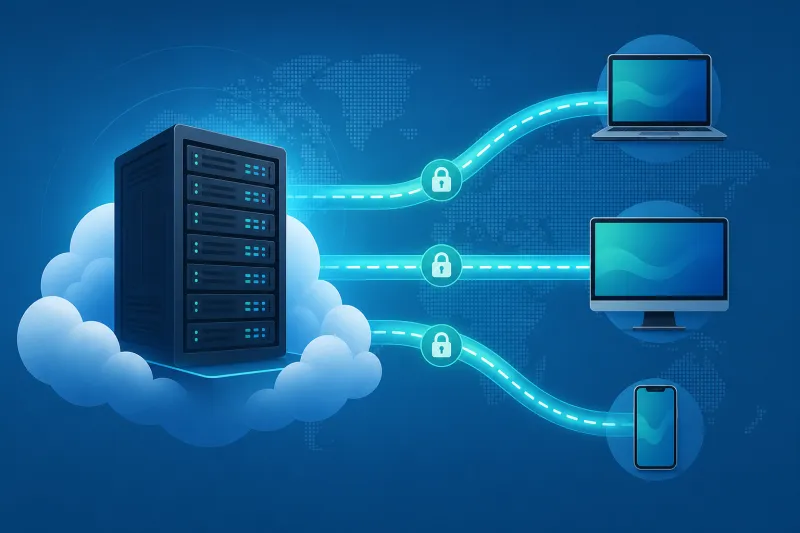
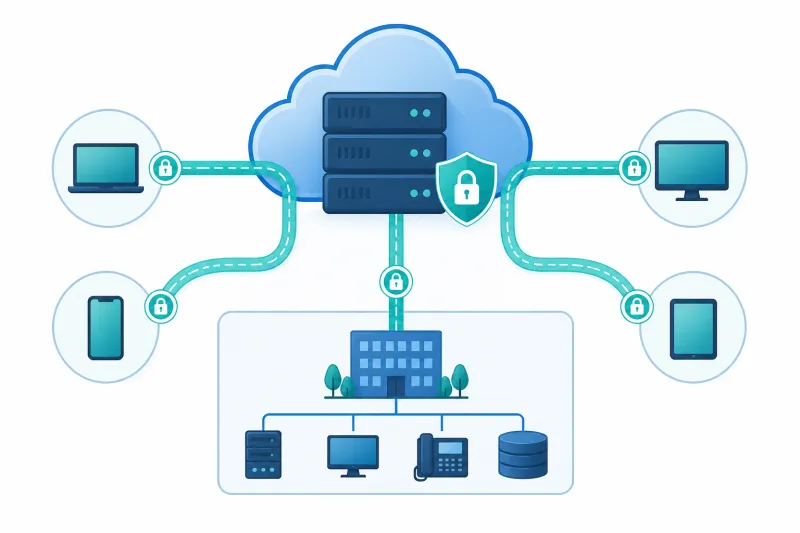
Self-hosting keeps the tunnel endpoint inside your cloud project. You decide region, retention, whether traffic is split-tunneled, and which CIDRs are reachable. For teams that already gate production access carefully, that consistency matters.
Reason 2: Predictable Cost Shape
Per-seat VPN SaaS pricing scales with headcount—even when most users need only occasional access to a private CIDR. Self-hosted cost is mostly:
- VPS instance hours
- Bandwidth/egress
- Engineering time (or a provisioning platform that reduces that time)
If you already pay a cloud bill, adding a small gateway fleet is often cheaper at moderate scale than another per-user subscription—if you automate. Manual peer management does not stay cheap past a few dozen people.
Reason 3: Integration With Existing Cloud Networking
Companies living on cloud VMs want VPN users to reach private services the same way bastion or mesh access would: security groups, private IPs, internal DNS. A gateway in your account can route into private networking without hairpinning through an unrelated vendor ASN.
On a simple droplet model (common with DigitalOcean), that might mean private networking between the VPN droplet and app droplets. On VPC-heavy clouds, it means attaching the gateway where your routes already live. Either way, self-hosting keeps the trust boundary aligned with your inventory.
Reason 4: Protocol and Architecture Freedom
Need WireGuard for performance? OpenVPN TCP for a locked-down client network? Regional endpoints in two continents? Split tunnel by default with full tunnel for a privileged group? Self-hosting lets you implement those choices without waiting for a vendor roadmap.
WireGuard especially lowered the barrier: smaller configs, strong performance on modest CPUs, clients on major OSes. The protocol made “just run a gateway” realistic for teams that would never have operated IPsec for fun.
Reason 5: Compliance and Audit Narratives
Auditors and customers ask where remote access lands, who can change access, and how revocation works. Answers are clearer when:
- Gateways are assets in your CMDB/cloud account
- Access changes go through your identity and change processes
- Logs land in your SIEM with your retention
Self-hosting does not automatically make you compliant. It makes the system describable in your existing control framework. That is often the real unlock.
Reason 6: Avoiding Consumer VPN Product Mismatch
Consumer VPNs optimize for streaming geolocation and marketing threat models. Company remote access optimizes for:
- Least privilege to private services
- Device onboarding and offboarding
- Stable regional performance
- Supportability by internal IT/ops
Using a consumer plan as corporate remote access usually fails on identity, inventory, and policy—even if encryption works.
What You Take On
Be honest about ownership:
| Responsibility | Notes |
|---|---|
| Patching OS and VPN packages | Ubuntu LTS helps |
| Key/peer lifecycle | Hire/offboard must be crisp |
| Firewall and exposure | Public UDP/TCP listeners |
| Capacity and regions | Measure; do not guess forever |
| Client documentation | Non-negotiable |
| Monitoring and backups of config | Gateways are production |
Teams that skip automation feel this as ticket load. Teams that template servers and configs feel it as a normal service.
TunnelFleet exists for the middle: automate provisioning and management of VPN servers on your cloud so self-hosting does not mean living in SSH. Today that automated cloud path is DigitalOcean; you can still self-host elsewhere manually if your org standardizes on another provider.
When Not to Self-Host
Consider buying a managed enterprise remote-access product when:
- You have no one who can own Linux networking
- You need deep IdP/device-posture integrations immediately and cannot build them
- Procurement requires a specific vendor certification you will not replicate
- Your scale and support model favor a 24/7 vendor SOC more than cloud VMs
Self-hosting is leverage for teams that already run cloud infrastructure. It is a trap for teams that wanted a checkbox without an owner.
A Practical Company Architecture
A pattern that works for many SMBs and product companies:
- Regional WireGuard endpoints near user clusters or near private resources
- Split tunnel by default to private CIDRs; full tunnel only where policy requires
- Optional OpenVPN TCP fallback for restricted networks
- Short-lived access discipline — remove peers on offboard the same day
- Bastion-like thinking — VPN grants network path; apps still require SSO/IAM
- Boring Ubuntu images — 22.04/24.04 LTS, automated updates or golden images
VPN is necessary but not sufficient access control. Pair it with identity on the applications.
Soft Costs and Political Costs
Finance sees SaaS seats clearly. Self-hosting moves cost into cloud accounts and salaries. That can be healthy if platform engineers already exist—or unhealthy if VPN becomes an unpaid side quest for a backend lead.
Successful self-hosted VPN programs look like other internal platforms:
- Named service owner
- SLOs (e.g. regional availability targets)
- Change windows for breaking MTU/endpoint changes
- Support tier definitions (what IT resolves vs what platform resolves)
Without that, self-hosting degenerates into a brittle wiki and a single droplet nobody wants to touch.
Security Ownership Boundaries
Clarify who handles:
- Gateway patching (platform)
- Laptop clients and MDM (IT/endpoint)
- Application authorization (app owners / identity team)
- Abuse complaints on egress IPs (security + platform)
Ambiguity here causes either duplicated effort or silent gaps—especially around full-tunnel exit reputation.
Migration Off Consumer or Legacy Tools
A typical migration sequence:
- Stand up WireGuard in one region; pilot with engineering
- Add identity-tied onboarding; measure support load
- Expand regions; migrate department by department
- Keep legacy VPN read-only/fallback for a defined overlap window
- Decommission legacy and cancel redundant seats
Do not big-bang every laptop on a Monday without a fallback profile.
Relationship to Zero Trust and BeyondCorp-Style Goals
Self-hosted VPN is sometimes framed as the opposite of Zero Trust. In practice many companies run hybrid controls:
- VPN (or other private connectivity) to reach non-public services
- Strong SSO, device checks, and per-app authorization on the services themselves
- Segmented routes so a VPN connection is not a master key to all CIDRs
You can tighten toward identity-aware access over time without pretending a consumer VPN subscription was ever the same as a controlled gateway. Self-hosting keeps the network component in your inventory while you improve app-layer controls.
Staffing Model That Works
A workable ownership model for a 20–200 person company:
- Platform/ops owns gateway images, monitoring, and regional capacity
- IT owns end-user device support and first-line “cannot connect” triage with a runbook
- Security owns policy (split vs full, logging retention, acceptance of TCP fallback)
- Hiring/HR ops triggers offboarding hooks that revoke peers
When one engineer “owns VPN” unofficially in their spare time, vacation risk equals outage risk.
Best Practices
- Assign a clear owner for the VPN service (ops/platform), not “whoever set it up once.”
- Automate server build and peer inventory from day one if you expect growth.
- Prefer WireGuard for new deployments; keep TCP fallback intentional and limited.
- Put gateways in cloud accounts/subscriptions that match your security boundary.
- Document split vs full tunnel policy in one page humans will read.
- Revoke access as part of HR/IT offboarding checklists, not as a monthly cleanup hope.
- Monitor CPU, bandwidth, and handshake failures like any production edge service.
- Review egress costs if you default to full tunnel.
Common Mistakes
- Treating a personal consumer VPN as company infrastructure.
- One global gateway for a distributed workforce.
- Never rehearsing rebuild after the only person with keys leaves.
- VPN-only security with flat internal networks and no app auth.
- Logging nothing—or logging everything forever without a retention plan.
- Manual
wgedits in production with no backup of peer lists. - Overbuying huge instances instead of fixing region and tunnel mode.
- Ignoring UDP firewall rules and declaring self-hosted VPN “unreliable.”
FAQ
Is self-hosted VPN more secure?
It can be, because you control path, keys, and policy. It can also be worse if you leave outdated images and orphaned peers. Security is operational, not a hosting adjective.
How many employees before self-hosting pays off?
Sometimes at 10 if you already run cloud and refuse per-seat pricing; sometimes never if nobody will own it. Run a simple cost model including engineering hours.
Do we still need SSO?
Yes for applications. VPN should not be your only gate to sensitive systems.
Where should we host?
Where your private resources and operational skills already are. DigitalOcean is a straightforward option for Ubuntu VPN droplets and is what TunnelFleet automates today; AWS/GCP/Azure are common when the rest of production already lives there.
Is WireGuard “business ready”?
Yes for many organizations when you add inventory, access process, and monitoring around it. The protocol is ready; your process must be too.
What about liability and abuse from exit nodes?
If you full-tunnel user internet egress through your gateway, you operate an exit. Prefer split tunnel when possible; know your cloud AUP; keep abuse contacts current.
Can developers self-serve access?
Yes with guardrails: approved CIDRs, expiry, logging, and automated provisioning. Self-serve without expiry is how former contractors linger.
How is this different from Zero Trust products?
Overlapping goals, different implementation. Many companies run VPN to private networks while adopting stronger identity per app. You do not have to pick a slogan; you have to pick controls that match risk.
Summary
Companies self-host VPNs to own the data path, align with cloud networking, control cost shape, and tell a clear audit story—especially now that WireGuard makes gateways operationally lighter. The trade is real ownership: patching, keys, capacity, and onboarding. If your team already runs infrastructure, that trade is often worthwhile. If nobody will own the service, buy a product with a vendor instead of collecting abandoned VMs.
If you want to automate VPN server deployment instead of configuring everything manually, TunnelFleet helps you provision and manage VPN infrastructure on your own cloud provider with minimal manual setup.
Share this article
Practical guides on VPN infrastructure, server automation, and self-hosted networking from the TunnelFleet team.
View all articles by TunnelFleet Editorial →